Consistency

I’m often asked by patients about ways they can improve their body, whether it be for mobility, weight loss, or strength.  One theme I find myself going back to and always reiterating is the importance of consistency.

In terms of mobility it is important to consistently work on it.  This does not mean the person needs to do hours upon hours of mobility work throughout the day.  However, one does need to be consistent in doing some sort of mobility work at least once a day.  This daily mobility work doesn’t even need to take an hour, it can just be 15 minutes of diligent work done daily.  The morning routine consists of taking every joint in my body through its maximum range of motion.  I personally like to do my daily mobility work early in my morning routine.  By doing this I know at least once in my day I will have challenged my joints to move into their end range.  If we consistently fail to do this overtime our bodies (muscles, ligaments, tendons, and joints) will recognize that we don’t use certain ranges and will proceed to change our bodies so that we may never get to those ranges.  Thus, we become immobile and stiff.

In terms of weight loss, it is not about how much weight can we lose in a week.  It is truly about how much weight can we lose over the course of the next 6 months.  If we go the route of crash dieting we may lose the weight, however we are more likely to gain said weight back the very next week when we go back into those unhealthy eating habits.  However, if we go for a steady slow progression of weight loss we will be more likely to keep that weight off if we were to fall off that healthy eating habit.  If you consistently eat well over time you will see that weight come off and stay off.

When it comes to strength training and having “gains” in muscle mass and strength being consistent is crucial especially if you want to gain size.  In the first month of training you really don’t gain any size of the muscle, however what you do gain is your brains ability to send more motor units (nerve power) to the muscle.  If you just do this and stop lifting after a month those motor units potential will decrease, and it will be like starting over from scratch again.  But if you keep that strength training up past that initial month and are consistently challenging your body and muscles, the body will adapt to those demands and increase in size.  These gains will be harder to lose.

Being consistent is difficult and it is important to make sure you have a good game plan to stay consistent.  One that helps me the most with staying consistent is starting slow and building upon your “wins”.  For example, don’t start out saying you are going to eat healthy every single meal.  This way doesn’t work because if you fail once you are more likely to just completely give up.  To piggy back onto this is don’t let one failure or one day ruin the progress you made.  In terms of dieting if you have a cheat meal don’t let that cheat meal roll over into the rest of the week.  Another technique on staying consistent is have someone with similar goals to help hold you accountable.  If there is a reason to skip a workout write it down and ask your accountability buddy if it is a reasonable reason to skip.  You will find that they will keep you honest and will help prevent you from skipping and falling off the wagon.  There are many more ways of staying consistent as these are just a few in a plethora of techniques at keeping you honest with yourself and staying consistent.
What does the Research say on Foam Rolling?

If you have ever been to the gym then you have most likely seen someone foam rolling.  You might have thought to yourself why are they doing that?  There are a multitude of reasons for foam rolling.  Let’s check out what the research says from this review:  The effects of Self-Myofascial Release Using a Foam Roll or Roller Massager on Joint Range of Motion, Muscle Recovery, and Performance: A Systematic Review.

Does foam rolling increase joint range of motion? 

Yes, several articles looked at this and they demonstrated there was an increase in range of motion of up to around 10°.  This effect lasted around 10 minutes after treatment.  Effects lasting longer than 10 minutes were not analyzed (ie. 20 minutes to 2 hours).  Effects were not shown to last a week later.  It was shown that roam rolling effects were increased when combined with static stretching after rolling.

Does foam rolling influence muscle recovery and delayed onset muscle soreness?

Yes, foam rolling following exercise induced muscle damage had a positive effect on healing.  Foam rolling was shown to decrease pain perception as well as having improvements in other performance measures when compared against a control group that did not foam roll after the muscle damaging workout.

Does foam rolling influence muscle performance?

No, foam rolling does not show a statistically significant difference on muscle performance.   However, foam rolling may change the perception of fatigue post exercise, which may allow you to lift longer.

Application of foam rolling and other techniques into your workout routine:

  1. Foam roll the areas of the body that will be getting used that day (30 seconds per body part) 2-5 sessions. (5 minutes)
  2. Stretch to further increase the range of motion of body parts just foam rolled. (2 minutes)
  3. Dynamic warm up to prep the movements that you would work out that day (5 minutes)
  4. Workout
  5. Cool down with foam rolling to reduce pain and delayed onset muscle soreness. (5 minutes)


Resources:

Cheatham SW, Kolber MJ, Cain M, Lee M. THE EFFECTS OF SELF‐MYOFASCIAL RELEASE USING A FOAM ROLL OR ROLLER MASSAGER ON JOINT RANGE OF MOTION, MUSCLE RECOVERY, AND PERFORMANCE: A SYSTEMATIC REVIEW. International Journal of Sports Physical Therapy. 2015;10(6):827-838.

DISCLAIMER: THIS WEBSITE DOES NOT PROVIDE MEDICAL ADVICE

The information, including but not limited to, text, graphics, images and other material contained on this website are for informational purposes only. The purpose of this website is to promote broad consumer understanding and knowledge of various health topics. It is not intended to be a substitute for professional medical advice, diagnosis or treatment. Always seek the advice of your physician or other qualified health care provider with any questions you may have regarding a medical condition or treatment and before undertaking a new health care regimen, and never disregard professional medical advice or delay in seeking it because of something you have read on this website.

3 Safe and Effective Core Exercises

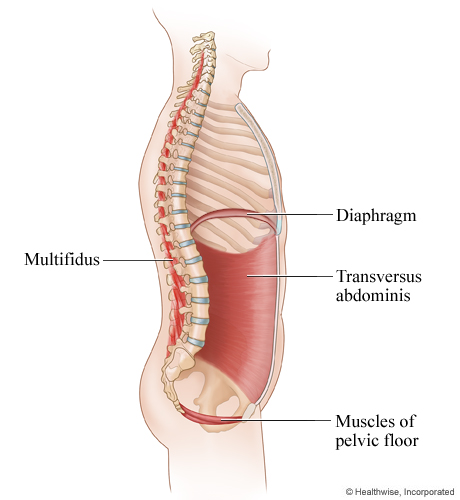
I’m often asked what are some of my favorite exercises for the core?  First, what is the core?  The core is the group of muscles that work together to stabilize the low back.   Picture below is the intrinsic stabilization subsystem (ISS) top, as well as a closer look at the anatomy (bottom).

Intrinsic-Stabilization-Subsystem

core-anatomy1

So what are these 3 exercises?  Well, I’m not the biggest fan of the crunch due to the increased pressure it causes on the disc, that can lead to low back pain.  I feel that for the general population that sits 10+ hours of the day it’s not a good idea.  Instead I suggest these 3 exercises to get you started:  dead bug, planks, and birddogs.  I like these exercises because they are easy to scale depending upon your skill level.  One aspect that needs to be carried over is proper breathing strategy.  If you need a refresher on breathing, check out my recent blog “Bring it to the Breath” or check the video out below.  Based on the principles of Dynamic Neuromuscular Stability (DNS), we must begin with the breath to properly aid in the stability of the core, without proper breathing and stabilization movement will be suboptimal, leading to an increased risk of injuries.  If you are unable to breath well in the position it will be best to work on this before progressing to these other exercises.

The dead bug is an excellent continuation from the breathing.  It works on forcing yourself to stabilize your core while moving an arm/leg/both.  We get the added benefit of having the extra proprioception from the contact the low back has with the ground.  This is also great way to train the arm to work in an open chain.  Remember to keep the position from breathing without compromising the breathing while moving your limbs.

The plank is another excellent option to work the core safely.  We will show a good progression from beginner to advanced in the front plank and side plank.  As before, remember to breath and to not compromise on form.  Keep a stiff, rigid, straight spine during the hold.

The final exercise rounding out this series is the bird dog.  This has an advantage of training the hip and shoulder in a closed chain activity working on stability while also working the hip and shoulder in an open chain fashion.  Make sure to maintain a neutral spine not over extending the low back and avoid really shifting side to side while performing.

Add these to your next day of core.  Remember it’s better to do fewer reps or less time more frequently to not compromise form than to do more reps for more time with cruddy form.


DISCLAIMER: THIS WEBSITE DOES NOT PROVIDE MEDICAL ADVICE

The information, including but not limited to, text, graphics, images and other material contained on this website are for informational purposes only. The purpose of this website is to promote broad consumer understanding and knowledge of various health topics. It is not intended to be a substitute for professional medical advice, diagnosis or treatment. Always seek the advice of your physician or other qualified health care provider with any questions you may have regarding a medical condition or treatment and before undertaking a new health care regimen, and never disregard professional medical advice or delay in seeking it because of something you have read on this website.

Foam Rolling the Hip

There are 20+ muscles that cross the hip joint meaning there are 20+ muscles that can exert a force on the hip joint.  In order to fully use our hip to the greatest ability we must have the proper mobility, tone, motor control, and strength.  One technique that can begin us on the path to great movement is foam rolling.  Foam rolling is beneficial because it can help us accomplish all four components.  Foam rolling has been shown to increase joint range of motion, decrease delayed onset muscle soreness following an intense workout, and does not decrease performance after rolling.

hip muscles

Credit: SDMESA

When foam rolling the muscles of the hip you will want to spend 30 seconds- 2 minutes a muscle group.  We will simplify the different muscles to say we will roll the booty, front, side, middle, and back of the leg.  You will want to do this with any hip, knee, low back problem as these muscles and the hip joint play an important part in all of these conditions.  I also like to go through this progression before and after using that region in the gym ie. leg and back/deadlift day.

Roll up and down the front of the leg, making sure to get all the way to the top.  Pause at the tender spots for a few seconds and bend and straighten the leg a few times on the tender spots.

If you suffer from a tight IT band make sure to do the tensor fascia lata (TFL) more than the IT band.  The TFL is the contractile portion of the of the IT band, so it is more beneficial and likely to cause a change in the tightness of the IT band.  With that said the muscle underneath the IT band the vastus lateralis is a muscle that can cause a lot of lateral thigh pain as well so be sure to roll that as well.

Sit on the roller and cross the leg over on the side that you will be rolling ie. Right ankle on left knee to work the right glute.  Roll back and forth over the booty.  Push down on knee to increase the stretch and effectiveness of the foam rolling.

Roll the medial thigh and keep the knee at 90 while rolling if a tender spot is found move the knee around to get a better stretch on the muscle.  Make sure to roll the whole length of the muscle.

Roll the back of the thigh out.  Lay the other leg on top to increase the depth of the roller into the muscle.  Work from the knee up to the ischial tuberosity (the bone you sit on).  Roll from side to side to find tender points and pause on those points.

DISCLAIMER: THIS WEBSITE DOES NOT PROVIDE MEDICAL ADVICE

The information, including but not limited to, text, graphics, images and other material contained on this website are for informational purposes only. The purpose of this website is to promote broad consumer understanding and knowledge of various health topics. It is not intended to be a substitute for professional medical advice, diagnosis or treatment. Always seek the advice of your physician or other qualified health care provider with any questions you may have regarding a medical condition or treatment and before undertaking a new health care regimen, and never disregard professional medical advice or delay in seeking it because of something you have read on this website.

Bring it to the Breath

Breathing is unique to all life forms.  From the sea sponge to humans to plants, we all breathe.  Even though we all breathe we might not be breathing the way we were designed to breath.  You might be thinking how can one breathe wrong?

Due to lifestyle choices and other factors such as sitting all day and high stress we tend to use a lot of our accessory breathing muscles; the scalene group, sternocleidomastoid, pectoral group, serratus posterior/anterior, and even the latissimus dorsi plays a role in breathing.  However, using these muscles too much to breathe can cause hypertonicity of those muscles and can leave them in a shortened state.  We only want to use these muscles to breath while doing activities that require more oxygen, such as, when exercising.

So, if we aren’t supposed to use those muscles what do we use?  The answer is the diaphragm.  The diaphragm attaches along the lower 6 ribs, xiphoid process and to the upper 3 lumbar vertebrae.  Beside the roles of inhalation and exhalation, the diaphragm plays a large role in aiding in the stabilization the low back via the Integrated Spinal Stabilizing System(ISSS).  The diaphragm and core help in the stabilization of the trunk when reaching, pulling, and other functional activities.  Test this yourself, feel your belly/core with one hand and with the other pick up a 5-pound weight with an outstretched arm.  Did you feel your core become stiff and tight?

breathing muscles

Now let’s discuss the correct way.  Begin with crocodile breathing by laying on your stomach and with each inhalation feel the belly push into the floor.  Then roll over on your back with your hips and knees bent into a 90/90 position and feet resting on a ball/chair etc.  Make sure the rib cage is down and not flared out and there is pressure into the floor through the back by keeping the ribcage down.  From this position rest one hand on the belly and the other hand on the chest and just breathe.  Pay attention to which hand is moving.  Is it the top or bottom hand?  It should be the bottom hand that moves and the top hand shouldn’t move until the hand on the belly is done rising.  Then move your hands to the side of your belly and focus breathing into your hands.   The end goal with this is to be able to breathe deeply into the pelvis and have a 360-degree expansion of the trunk.  This will be difficult at first, but will become second nature with practice.  Watch the video for the breathing progression.


DISCLAIMER: THIS WEBSITE DOES NOT PROVIDE MEDICAL ADVICE

The information, including but not limited to, text, graphics, images and other material contained on this website are for informational purposes only. The purpose of this website is to promote broad consumer understanding and knowledge of various health topics. It is not intended to be a substitute for professional medical advice, diagnosis or treatment. Always seek the advice of your physician or other qualified health care provider with any questions you may have regarding a medical condition or treatment and before undertaking a new health care regimen, and never disregard professional medical advice or delay in seeking it because of something you have read on this website.

3 Exercises to Increase Thoracic Spine Mobility

The thoracic spine is an integral component of shoulder and low back health.  I mentioned this in my first blog while discussing the joint by joint approach to treatment.  I often see shoulder and low back problems being caused by a lack of mobility in the mid back.  If we cannot extend through the thoracic spine while raising our arms overhead, whether when throwing a ball or reaching for the top shelf, compensations will happen.  A common compensation is extension the low back.  This can cause repetitive micro traumas and can eventually lead to low back pain.  A quick test to see if thoracic mobility is a problem is the lumbar locked rotation test.

If unable to reach 50 degrees of rotation each way you have a mobility restriction in the mid back and you’ll need to have ways of increasing it.  The first exercise that I go to is foam rolling the thoracic spine.  This is something that I see a lot of people doing at the gym.  I love seeing this at the gym, but I do want to make a few tweaks to the form that I see when at the gym.  I try to tell my patients to keep their ribs depressed and to not allow the ribs to flair out because when they start to rise the lower back starts to extend and we are failing to properly target mobility for the thoracic spine.  Start by just rolling up and down the back a few times to aid in bringing blood flow to the area.  Then, place the foam roller on the mid to low back and use each exhalation to help fold the back over the roller. Perform 3-4 exhalations before moving up the spine.  The hands can aid in supporting the neck.  I threw in some bad technique there where I allowed my ribs to come up.  We do not want this.

The second thoracic mobility exercise I really like is the cat-camel.  To do this begin on all fours, while maintaining a stable shoulder and scapula, sink the chest down to extend the thoracic spine then arch and round the back.  During the extension phase keep the head tuck instead of jutting the chin out.  Repeat this 10-20 times.  I like this because it is good for getting motion into the spine and in this case thoracic extension.  The last few reps I let the shoulder go, which is what we do not want to do.  I apologize for the dark video.

The last exercise in this series is the side-lying thoracic rotation stretch.  Lay on your side with the top leg supported by a foam roller, pillow, etc. in a 90/90 position.  Have the arms out in front and with the top arm rotate away from your leg while attempting to get the top shoulder to the ground, while maintaining the knee contact on the foam roller. When at the end of the range take some 3-5 deep breaths and feel yourself getting deeper into the movement with each exhale.  Repeat 10 times each way.

Go back to the original test to see if these 3 exercises were able to increase your mobility

DISCLAIMER: THIS WEBSITE DOES NOT PROVIDE MEDICAL ADVICE

The information, including but not limited to, text, graphics, images and other material contained on this website are for informational purposes only. The purpose of this website is to promote broad consumer understanding and knowledge of various health topics. It is not intended to be a substitute for professional medical advice, diagnosis or treatment. Always seek the advice of your physician or other qualified health care provider with any questions you may have regarding a medical condition or treatment and before undertaking a new health care regimen, and never disregard professional medical advice or delay in seeking it because of something you have read on this website.

5 ways to Increase Ankle Mobility

In the last post, we talked about ankle mobility and presented a test to determine if your ankle had enough mobility.  I know my ankle was lacking and could use some more mobility work, so I thought I would share what I did to increase my mobility.

Before starting, do the ankle mobility test to determine the starting point, at the end we will retest to see if what we did actually worked .

The first exercise that I did to help was foam rolling the calf, I like to use the lacrosse ball instead because it is more focal in the treatment area compared to the broader contact of the foam roller.  To do this we are going to just roll up and down the calf as it rests on the ball, to get more pressure lay the other leg on top.  While rolling, I run my ankle through plantarflexion and dorsiflexion to get a movement component.  With this exercise, we are decreasing the neurological tone of the muscle in hopes of changing how the muscle moves with an improved range of motion.

I want to follow rolling the calf with rolling the plantar fascia.  The plantar fascia is part of the posterior chain which can hinder ankle mobility.  To do this, we will just step onto a lacrosse ball and roll all over the bottom of the foot.

Following the two rolling drills we will follow it up with the wall gastroc-soleus complex stretch.  We want to hold these stretches for at least 30 seconds if not more.  A sustained hold will work or we can slowly pulse deeper into the stretch.  There will be 2 parts to this stretch the first part the leg will be straight and the second will be with the knee slightly bent.

The fourth drill we want to do is a mobility drill working on the ankle joint itself.  For this we will need a decently heavy band.  The band will go over the part of the ankle that isn’t moving (talar dome) and pulling it posterior and inferior.  Once the band is in place go into ankle dorsiflexion and working back and forth in all dorsiflexion positions.

The last exercise we want to do brings in more of a functional movement with the deep squat.  Sink all the way down into the hole and work the knees in and out and shifting your weight back and forth.   Don’t allow the heels to come off the floor.

Finish off the mobility work with just some deep, slow, weighted goblet squats.  Make sure to control the descent with a 4 count and 5 second pause at the bottom with some nice deep belly breaths.  This is like hitting the save button on the mobility work.

The last thing I want you to do is retest against your baseline.  Try doing this for a week to see how much your ankle mobility can improve.


DISCLAIMER: THIS WEBSITE DOES NOT PROVIDE MEDICAL ADVICE

The information, including but not limited to, text, graphics, images and other material contained on this website are for informational purposes only. The purpose of this website is to promote broad consumer understanding and knowledge of various health topics. It is not intended to be a substitute for professional medical advice, diagnosis or treatment. Always seek the advice of your physician or other qualified health care provider with any questions you may have regarding a medical condition or treatment and before undertaking a new health care regimen, and never disregard professional medical advice or delay in seeking it because of something you have read on this website.

A Stack of Joints:  The Joint by Joint Approach

The joint by joint approach is a way I, and many others, look at the body in regards to treatment and training.  It was first described by Gray Cook and Mike Boyle as a way of simplifying the body by regions and what it needs.

This approach states that each joint either needs mobility or stability.  It all starts at the foundation.

  • Foot- Stability
  • Ankle- Mobility
  • Knee- Stability
  • Hip- Mobility
  • Low Back- Stability
  • Thoracic- Mobility
  • Scapulothoracic- Stability
  • Shoulder- Mobility
  • Lower and mid cervical- Stability
  • Upper cervical- mobility

If any joint complex above is lacking in what it needs; there will be compensations above and below.  I like explaining this using the ankle as an example in terms of the squat.  The ankle is a common area that loses mobility mainly in dorsiflexion.  As you descend into a squat the knee translates over the toes and in a perfect situation between the 1st and 2nd ray.  However, a common problem I see is as the knee translates forward the ankle runs out of mobility causing the knee to cave inward in a valgus stress.  This compensation causes some loss of stability and faulty mechanics at the knee.  The body also compensates at the foot with the arch collapsing and turning outward when out of ankle mobility.

Test this out yourself.  Have your foot approximately 4 inches away from the wall or a fist and a thumb as seen in the video below.  Pretend like there is a laser on your knee and the laser dot doesn’t move from the starting position as you attempt to touch your knee to the wall without your heel coming off the ground.  To fail this test is not touching the knee to the wall, medial arch collapses, knee goes to the inside or the outside of foot.  If any of this happens the ankle does not have enough mobility.

Another example that is a common problem that I always see in the office is restricted thoracic spine.  Thoracic mobility has implications for the shoulder and low back as well as elsewhere.  Just as a mobility problem in the ankle caused compensations above and below, the thoracic spine has implications above and below.  I see this most with overhead shoulder movement, if we don’t have enough T-spine mobility to go completely overhead we will compensate by extending in the lumbar spine to fake full overhead mobility.

A quick test for thoracic mobility is the lumbar locked rotation test.  Start with sitting back onto the heels and have forearms on the ground in front.  Take one hand and put it behind the back and rotate that way.  Passing this test would be 50 degrees of rotation each way.  A failure would be shifting to one side to gain more rotation, excessive effort in one or both ways, not getting to the required 50 degrees and significant asymmetry.

It is important to keep this joint by joint approach in mind in treatment as well as in the gym with training.  Remember to mobilize the joints that need to have mobility and stabilize the areas that need stability.  If you do this you will be less likely to compensate and have faulty movement patterns, which can lead to pain and injury.

These are just a few test that check mobility.  Stay tuned to see how we can increase mobility in these joints.


DISCLAIMER: THIS WEBSITE DOES NOT PROVIDE MEDICAL ADVICE

The information, including but not limited to, text, graphics, images and other material contained on this website are for informational purposes only. The purpose of this website is to promote broad consumer understanding and knowledge of various health topics. It is not intended to be a substitute for professional medical advice, diagnosis or treatment. Always seek the advice of your physician or other qualified health care provider with any questions you may have regarding a medical condition or treatment and before undertaking a new health care regimen, and never disregard professional medical advice or delay in seeking it because of something you have read on this website.

What to Expect?

Hi guys just wanted to start out this blog by saying what I would like it to be.  I would like it to be a resource for anybody that wants to learn more about their health and fitness. I will try to put out useful information regarding health and fitness in hopes that you will take what you learn here and apply to your own life.   If you have any questions or topics that you want to learn about just drop me a comment so I can answer them for you.


DISCLAIMER: THIS WEBSITE DOES NOT PROVIDE MEDICAL ADVICE

The information, including but not limited to, text, graphics, images and other material contained on this website are for informational purposes only. The purpose of this website is to promote broad consumer understanding and knowledge of various health topics. It is not intended to be a substitute for professional medical advice, diagnosis or treatment. Always seek the advice of your physician or other qualified health care provider with any questions you may have regarding a medical condition or treatment and before undertaking a new health care regimen, and never disregard professional medical advice or delay in seeking it because of something you have read on this website.